Accolade
2024
Multi Step Broker 0->1 CRM Workflow Management
Accolade had market data and an existing renter facing app, but no product direction for the broker side of the business. I ran research across 34 interviews and 8 competitor platforms, and it pointed away from our original hypothesis. The bottleneck was not property discovery. It was the broker, who sits at the center of every transaction and runs the entire deal on WhatsApp, phone calls, spreadsheets and memory. I designed a broker first CRM MVP that turns that scattered work into one operational system. It reduced lead management steps by 68 percent and saved brokers roughly 6 hours a week.
Overview
Context
Accolade is a New York based PropTech company that wanted to enter India's commercial real estate market. They came to the project with two assets and one gap. They had a large volume of market data and an existing renter facing mobile app. What they did not have was a product, a defined user, or a point of view on what to build next.
India's brokerage market is one of the largest in the world and almost entirely undigitised. Over 500,000 brokers operate in it. Most record client data manually and rely on memory to hold deals together.
Role and Contribution
I worked on the project end-to-end as a Product Designer, contributing across research, systems thinking, UX, and visual design. I conducted user interviews, contextual inquiry, and secondary market research to understand how commercial real estate brokers operate in India and identify workflow gaps within the ecosystem.
I helped define the zero-to-one product direction by synthesizing insights into opportunity areas, journey maps, information architecture, and core system logic. I then translated these workflows into high-fidelity designs and interactive prototypes for the broker CRM experience.
Hypothesis
My starting hypothesis was we assumed the fragmentation was a discovery problem, that renters and buyers lacked good tools to find property. We began by exploring how discovery could be improved.
Research
Research Revealed That Brokers Were the Operational Center of the System
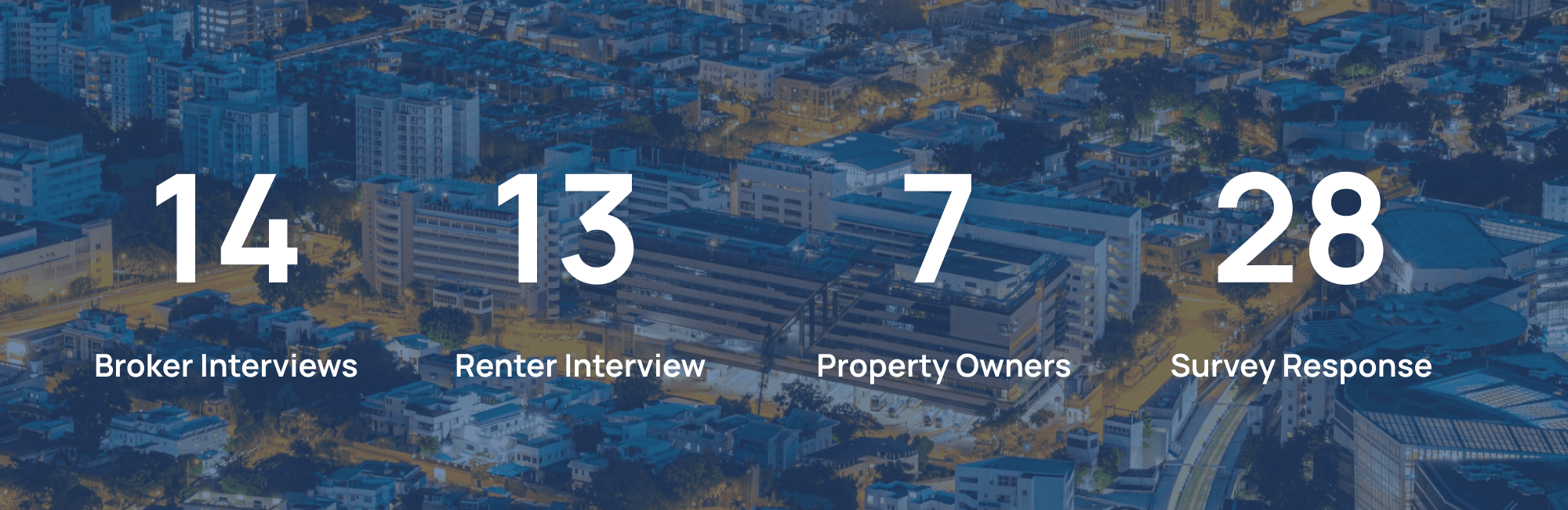
I ran interviews with renters, brokers and PropTech professionals, plus contextual inquiry, ecosystem mapping and competitive benchmarking across 8 platforms. A different pattern surfaced almost immediately.
The market gap made this worse rather than better. Platforms like MagicBricks and 99acres are built for renters and buyers searching for listings. Nothing existed for the operational work that happens after a lead arrives.
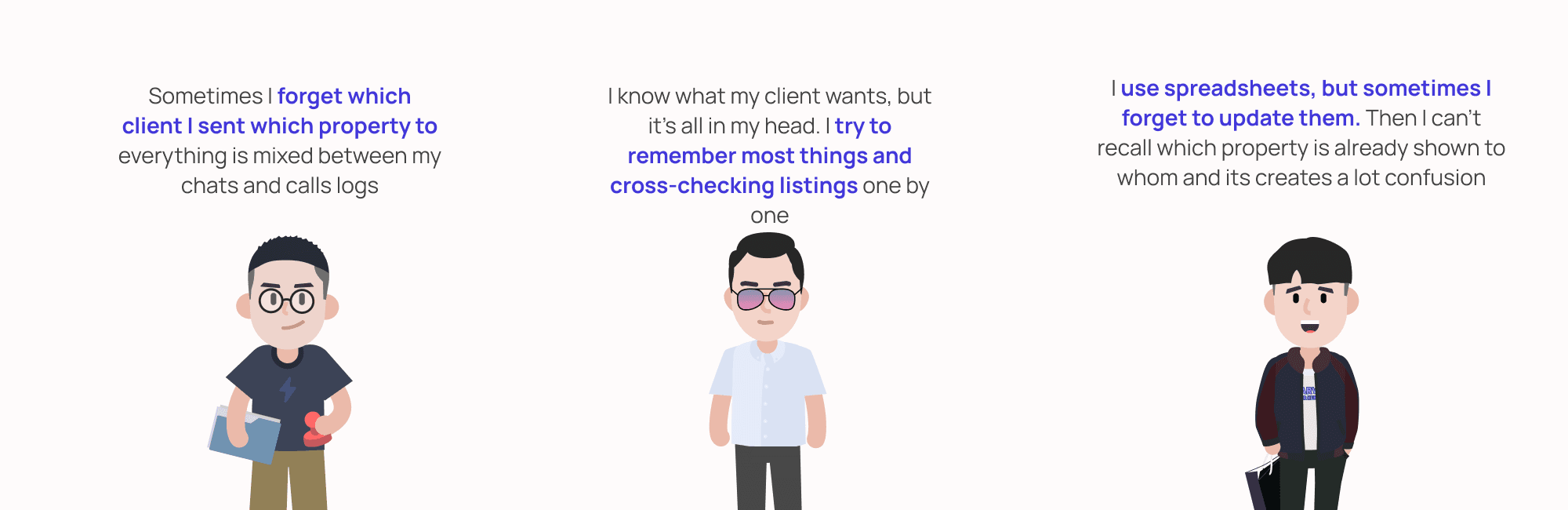
User Interview Quotes
Four Insights defined the project
Brokers were not struggling with lead generation. They were struggling with lead coordination.
Client information lived across separate tools, which created repeated conversations and lost context.
Lead tracking became mentally exhausting at scale because the workflow was memory dependent.
Existing PropTech tools are optimised for discovery, not for daily operations.
Ecosystem Mapping
Ecosystem mapping made the strategic case clear: brokers are the connective tissue between property owners, renters and platforms. Improving their workflow lifts the entire transaction funnel. They manage listings, site visits, negotiations, paperwork and coordination between owners and renters. All of it runs through WhatsApp, phone calls, spreadsheets and scattered notes.
That fragmentation produced a specific set of failures: duplicate leads entered more than once, clients repeating requirements they had already explained, no visibility into where a deal actually stood, and follow ups that disappeared entirely. Brokers were spending more time reconstructing context than closing deals.
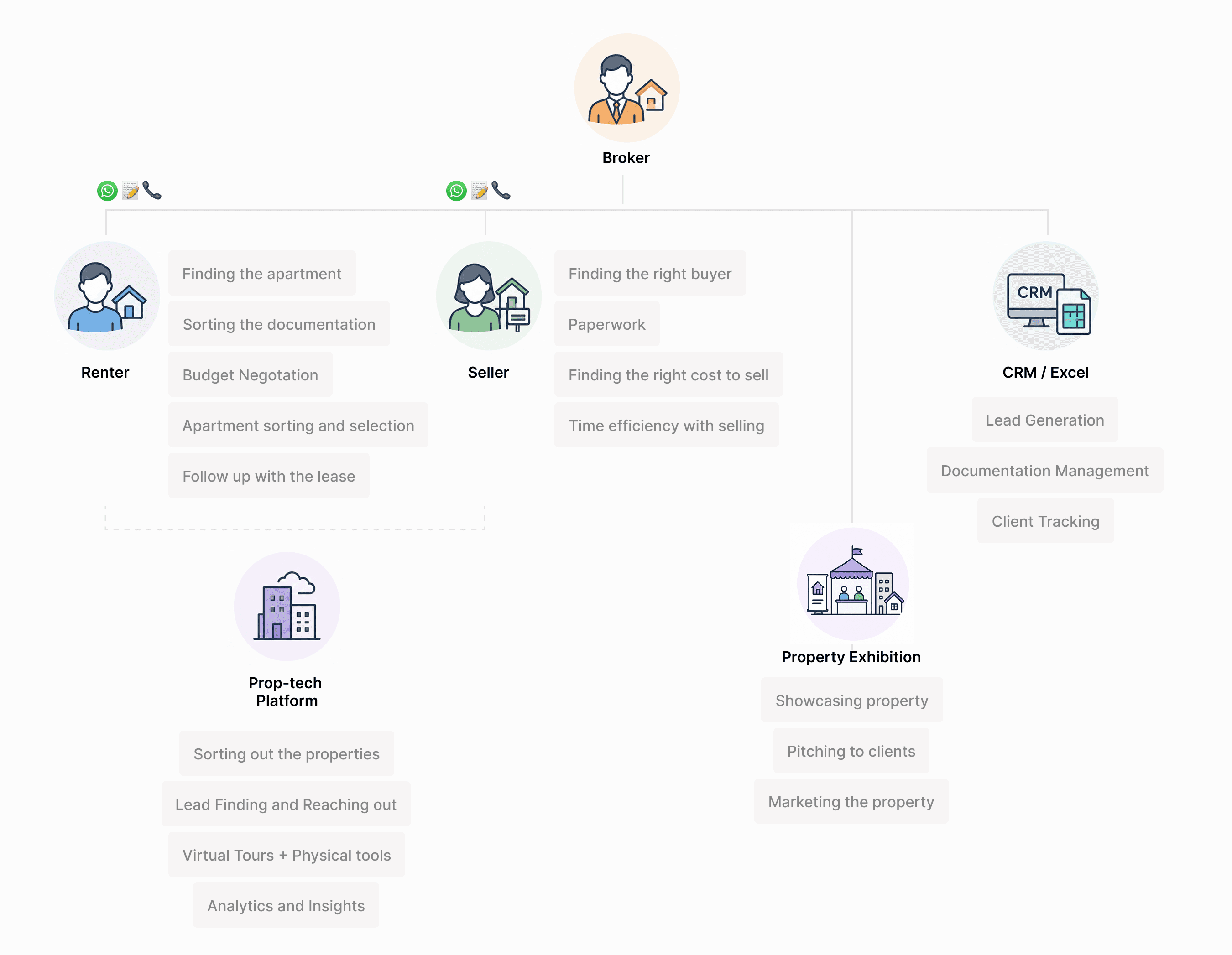
Real Estate Ecosystem Mapping
Pivot
AI Preference matching model with brokers that did not worked out
Before the pivot we tested a preference matching model with brokers. The idea was to score properties against stated client preferences and surface the best match. Brokers rejected it for three reasons:
It felt like replacement, not support. Matching scores bypassed the judgment that brokers consider their actual professional value.
Stated preferences decay fast. Client requirements shift within days of starting a search, so a model built on intake data is stale almost immediately. We needed to track what clients do, not what they said once.
Onboarding cost was fatal. Brokers in tier 2 and tier 3 cities are time constrained operators. Anything that required 20 minutes of learning would be abandoned.
New Direction
Our hypothesis was wrong and so we pivoted from "How do we match renters to properties faster?" to "How do we help brokers manage leads faster?"
Three things changed as a result:
Scope: from a preference matching model I shifted to a lead transparency and workflow model.
Mental model: from "match properties" to "understand clients and manage their changing preferences."
Product logic: from static intake of data to behavioral signals tracked over time.
System
System Architecture
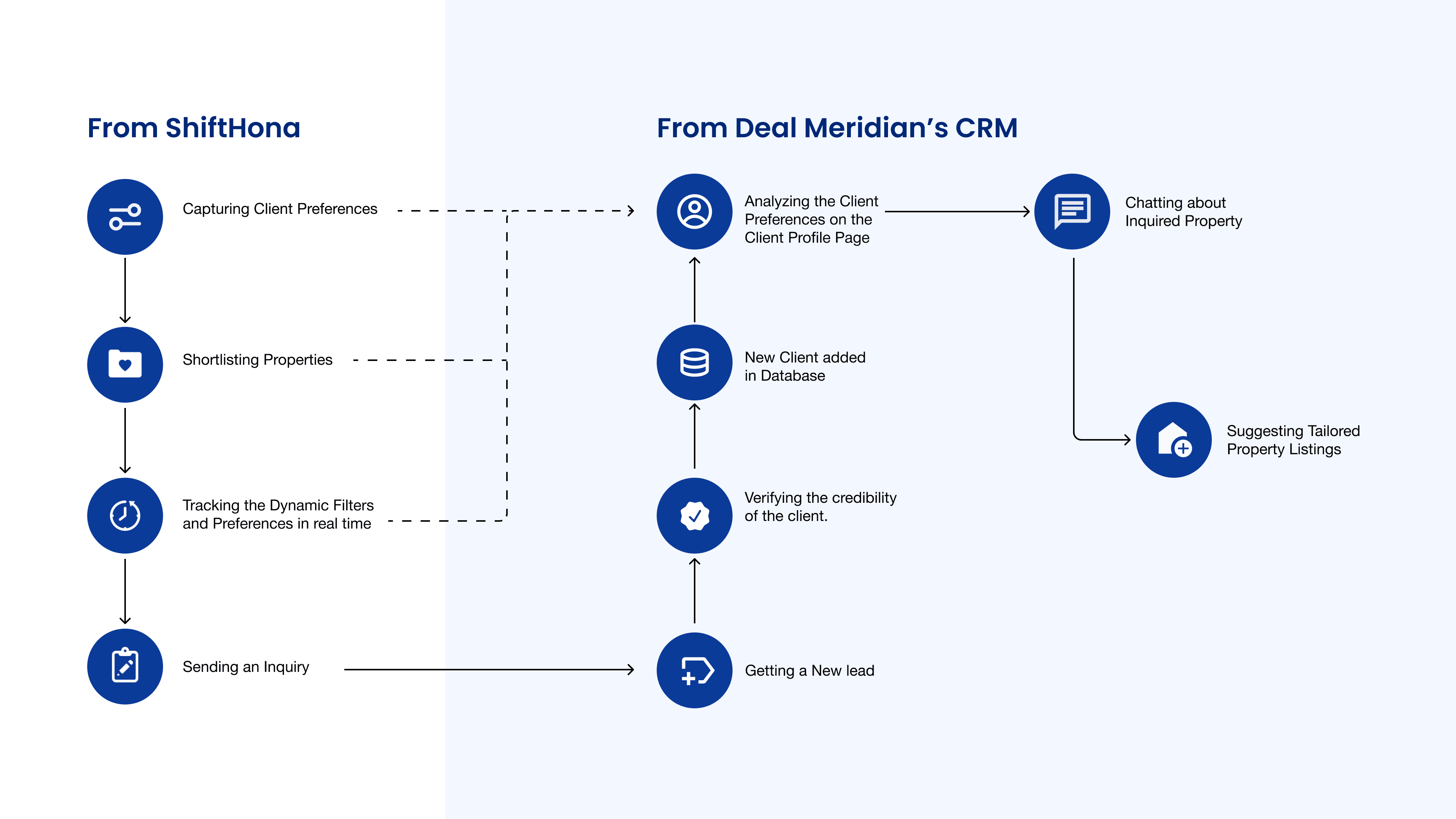
Accolade already had a renter facing mobile app, so I designed the CRM as one half of a two sided system rather than a standalone tool. The renter app captures preferences, intent and behavioral signals. Those flow into the broker CRM, which organises them into structured workflows that support the broker's decision rather than making it for them.
Designs
User flow and Decisions
Intent is behavioral and explained, not scored. High, Medium and Low intent are derived from observable signals: inquiry submissions, property viewing activity, and whether browsing behavior matches the stated budget. The signals themselves are shown on the card. This was the direct answer to the trust problem that killed the first concept.
The broker stays in control. Accept or Deprioritize, with the broker free to disagree with the system. Lead intent is treated as dynamic and context dependent rather than a fixed property of a person.
Soft deprioritization instead of deletion. Deprioritized leads leave the active view but stay in the system and resurface automatically when engagement behavior changes. Brokers lose nothing by clearing their pipeline, which is what makes them willing to clear it.
Stated preference and observed behavior sit side by side. In the client profile, the left panel holds what the client said they want and the right panel holds what they actually did. The gap between the two is the insight, so the layout makes that gap visible instead of merging the two into one summary.
Status tags carry the navigation load. In the client database, stage tags replace filtering and manual sorting. Preference context sits in the table row so brokers can evaluate without opening a profile.
Matched properties come to the workflow. Property matches surface inside the lead card and client profile rather than requiring a separate search, so brokers open a conversation already holding options.
Userflow

Impact
Brokers were able to complete core tasks reviewing leads, understanding client preferences, and tracking progress with significantly fewer steps.
I tested the MVP with 10 brokers and received positive feedback on how the system simplified their day-to-day workflow. Instead of spending time organising scattered information across multiple tools, brokers were able to focus more on understanding client needs, managing property searches, and progressing deals more efficiently.
68%
Reduction in lead management steps
~ 6 hrs/week
Estimated reducing in lead-handling effort
30%
Increase in lead prioritization
50%
Reduction in tool-switching
Reflection
Limitations and reflection
Validation was prototype based with 10 brokers. The next step is testing long term adoption in live environments, where relationship driven behavior and habit are harder to shift than a task based usability test can capture.
The hardest part of this project was designing structure for a market that has almost none. There was no standard workflow to build on and no existing product direction, which meant constant tradeoffs between structure and the flexibility brokers actually rely on.
The biggest takeaway: good product design here was not about adding features. It was about removing chaos. The most valuable thing I did was recognise that the research contradicted our hypothesis and reframe the problem at week 4 rather than defending the original scope.
If I continued, I would explore how AI could help brokers read preference patterns and prioritise leads without eroding the human judgment that is the core of their work.

