Delivered
Workflow Optimization
0 - 1 Flow
MVP Design
Build a 0 to 1 Broker MVP CRM system reducing process steps by 40% and saving brokers ~ 6 hours/week in lead handling.
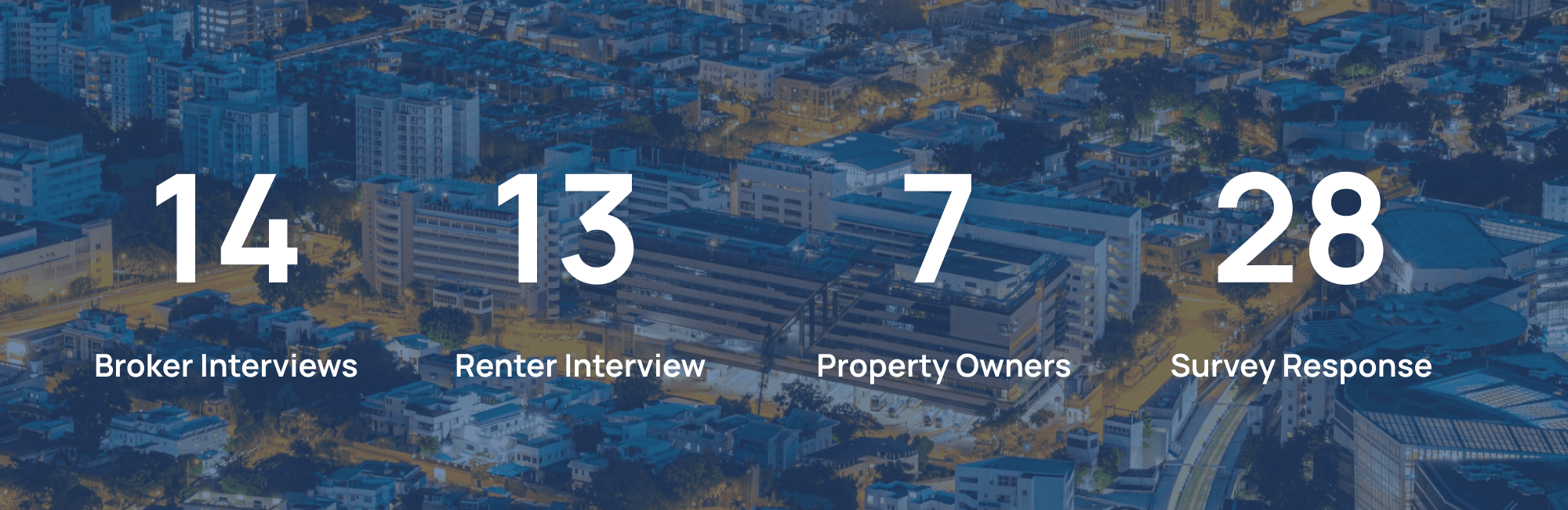
Accolade, a New York–based PropTech company, wanted to explore opportunities within India’s fragmented real estate market. While they had access to large amounts of market data, there was no existing product or clear direction on what the system should be. Over 12 weeks, we narrowed the scope by focusing on broker workflows and lead management, an area that repeatedly surfaced during research as highly fragmented and underserved. Through research across 8 competitor platforms and 34 interviews, I helped define and design a zero-to-one broker CRM MVP that streamlined lead handling, reduced workflow complexity, and improved how brokers manage clients, properties, and communication and built a broker-focused workflow ecosystem that centralized communication, lead tracking, and coordination across fragmented real estate operations.
Team
Team of 7 designers and researcher and 3 stakeholders.
Company
Deal Meridian (Name changed to Accolode) , New York, USA
Timeline
12 weeks (Research-Informed MVP product design)
Methods Used
User interviews · Journey mapping · Market Taxonomy · Competitive benchmarking · System architecture · Information architecture · Iterative wireframing & prototyping · Cross functional collaboration · Usability Testing
Project Type
Real Estate · System Design · Behaviour Design · SAAS Design · MVP Design · 0 -> 1 workflow
Context
Accolade wanted to rethink how commercial real estate brokers in India manage fragmented deal information. Brokers relied on spreadsheets, emails, calls, and scattered documents, making it difficult to track leads and maintain visibility across deals and teams.
The Goal
Understand how commercial real estate brokers in India manage deals, communication, and client relationships, and identify workflow gaps that existing PropTech tools fail to support.
Based on these insights, the objective was to define and design an MVP that simplifies the workflow within a fragmented real estate ecosystem.
My Role and Responsibilities
I worked on the project end-to-end as a Product Designer, contributing across research, systems thinking, UX, and visual design. I conducted user interviews, contextual inquiry, and secondary market research to understand how commercial real estate brokers operate in India and identify workflow gaps within the ecosystem.
I helped define the zero-to-one product direction by synthesizing insights into opportunity areas, journey maps, information architecture, and core system logic. I then translated these workflows into high-fidelity designs and interactive prototypes for the broker CRM experience.
Problem Space
Our Initial Hypothesis Focused on Property Discovery Problems
Our initial hypothesis was that India’s real estate experience was fragmented because renters and buyers lacked good digital tools for property discovery and search. With multiple PropTech platforms already in the market, we initially explored how discovery experiences could be improved and streamlined.
But as we conducted interviews with renters, brokers, and PropTech professionals, a different pattern started to emerge.
Research Revealed That Brokers Were the Operational Center of the System
At the center of every transaction sat the broker. Brokers were managing everything from property listings and site visits to negotiations, paperwork, and deal coordination. Yet most of this work was being handled through WhatsApp, calls, spreadsheets, memory, and scattered notes, with no structured system to support them.
This fragmentation created repeated renter entries, duplicate leads, multiple calls with no visibility into progress, disconnected property management, and poor tracking of client preferences or follow-ups. Brokers spent more time organizing information and remembering context than actually managing deals.
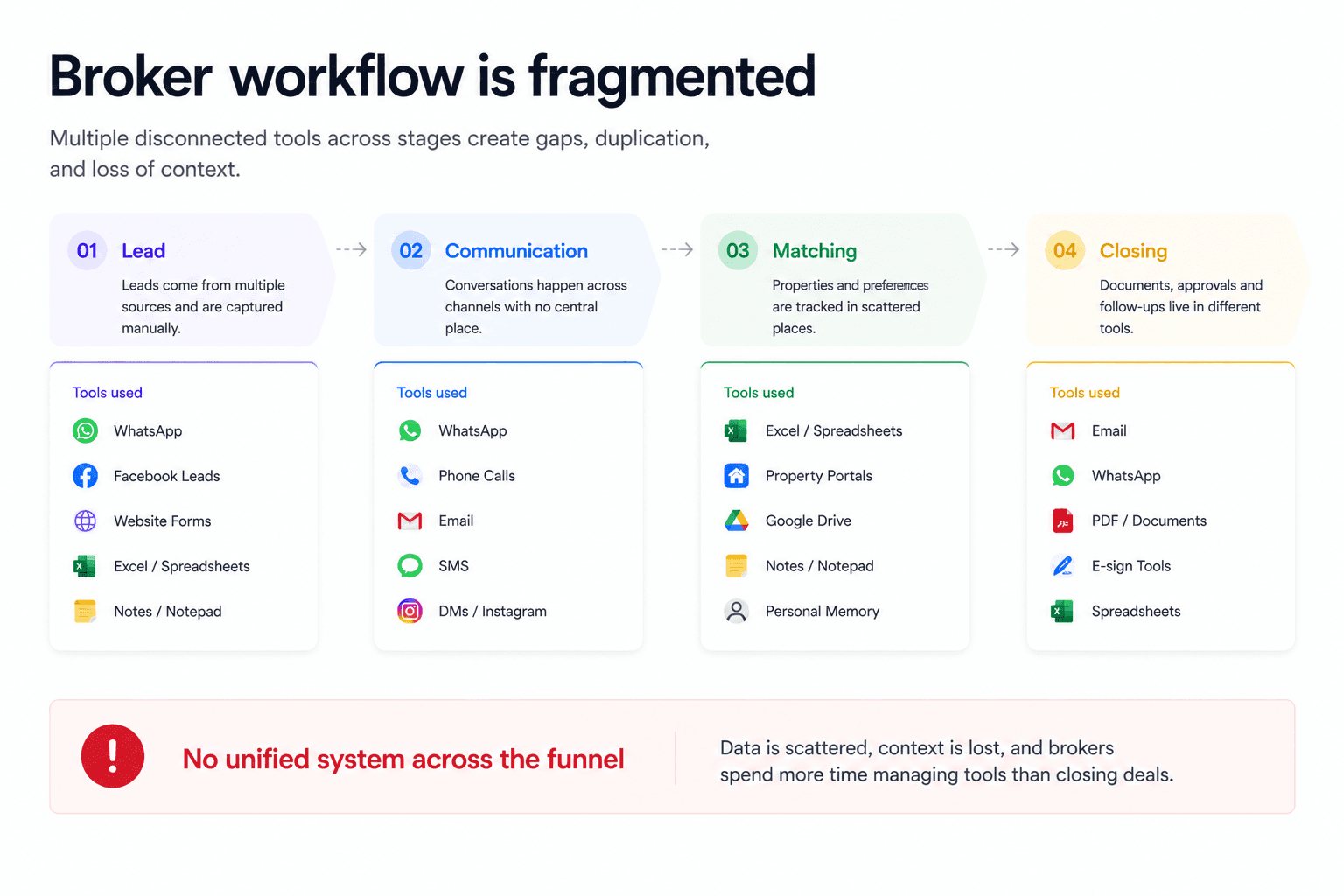
Brokers handle everything from matching renters to properties, but they manage this using calls, WhatsApp with no structured system.
Shift in the project scope
We realized the problem wasn’t simply about helping renters discover properties better, it was about fixing the fragmented workflows behind the scenes. Instead of building another discovery platform, we scoped down and focused on broker workflows, believing that optimizing these workflows would create a larger impact across the ecosystem by improving lead management, communication, property coordination, and overall transaction efficiency.

Solution
Designed an MVP Broker-first CRM to bring structure to their workflow
Since brokers are the operational backbone of India’s real estate ecosystem, I focused the solution around improving their workflows. I designed a broker-first CRM that addressed three major gaps in the market that are duplicate lead management, fragmented renter communication and preference tracking, and the lack of structured lead qualification and prioritization.
Impact
We tested the MVP with 10 brokers and received positive feedback on how the system simplified their day-to-day workflow. Instead of spending time organising scattered information across multiple tools, brokers were able to focus more on understanding client needs, managing property searches, and progressing deals more efficiently.
68%
Reduction in lead management steps
~ 6 hrs/week
Estimated reducing in lead-handling effort
30%
Increase in lead prioritization
50%
Reduction in tool-switching
Brokers were able to complete core tasks reviewing leads, understanding client preferences, and tracking progress with significantly fewer steps.
Brokers were able to evaluate leads 2–3X faster during testing → ~60–70% reduction in back-and-forth clarification questions before initial contact
Reduced tool-switching from 3–4 tools to 1 unified system → ~50–60% reduction in context switching during core tasks.
Research
We initially thought the problem was property discovery. Research revealed the real operational bottleneck was broker coordination and fragmented workflow management behind the scenes.
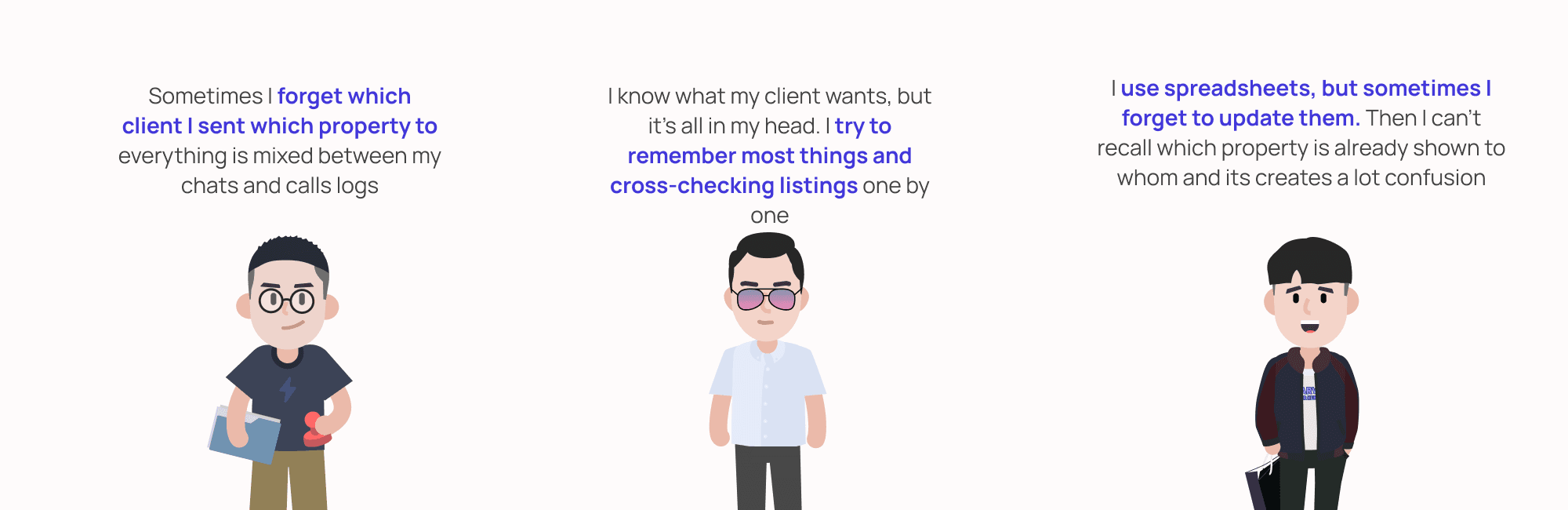
Broker's Interview Quotes

Broker's Journey Map
Key Insights
Brokers were not struggling with lead generation, they were struggling with lead coordination.
Important client information was spread across tools so this created repeated conversations and missed context.
Lead tracking became mentally exhausting at scale because brokers were relying on memory-heavy workflows
Existing proptech tools are optimized for discovery and not for daily operations.
Understand the Ecosystem
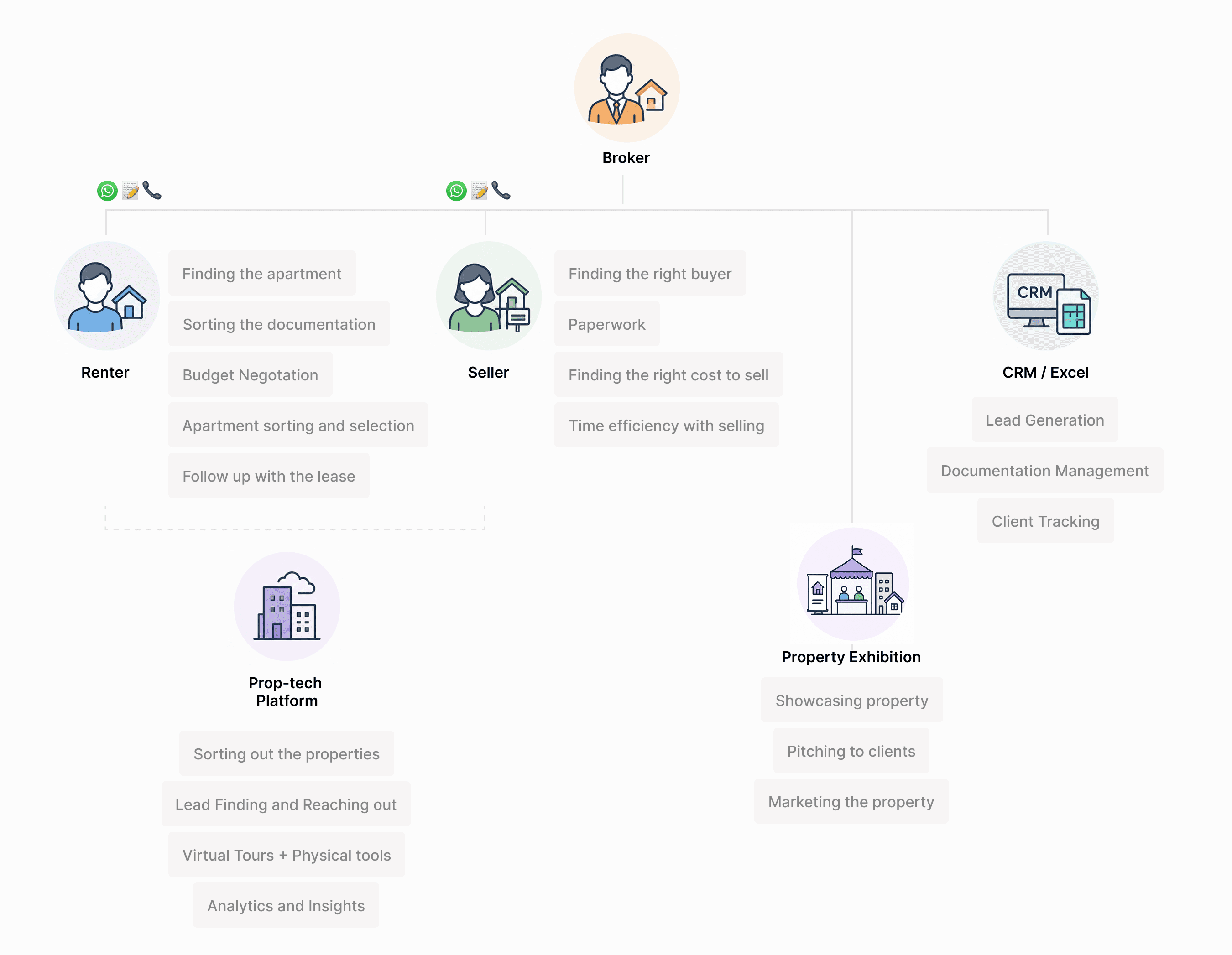
Broker Ecosystem
Through these user interviews and ecosystem analysis, we discovered that brokers sit at the center of this unorganized ecosystem they act as a connectors between property owners, renters, and platforms yet lack the digital tools to manage their workflows efficiently.
This insight helped us focus our solution on streamlining and structuring broker operations, with the belief that empowering brokers can uplift the entire real estate interaction funnel.
Secondary Research
A $265B Market Running on Fragmented Workflows, WhatsApp and memory
Market SIze
500K+ brokers, almost none of them digitised
India's real estate brokerage network is one of the largest in the world. Most agents record data manually, rely on memory, and have no structured system for managing clients or leads.
Market Gap
No end-to-end CRM exists for brokers
Existing tools (MagicBricks, 99acres) are built for renters and buyers. No platform integrates into how brokers actually work — matching clients, tracking conversations, closing deals.
Initial direction was a preference matching model for broker
The first hypothesis was to automate property matching using preference scores. If we surface the right properties at the right time, brokers will be able to close deals faster. We tested rough concepts with brokers. but they rejected the idea. Three problems made it untenable:
Brokers rejected scores outright. They felt bypassed by the system, not helped. The system felt like it was replacing their judgment, not supporting them enough.
Client preferences in change constantly during a search. A matching system built on initial preferences becomes inaccurate within days, so we needed to track what clients do, not just what they say.
Brokers in tier 2/3 cities are time-constrained operators. They won't invest 20 minutes learning a new tool. Anything requiring behavioral change at onboarding would be abandoned.
Pivot : Reframed the direction of the problem statement
By week 4, our research revealed that the core issue was not property preference discovery, but fragmented broker operations. We pivoted from building a new preference model to designing a workflow optimization platform focused on lead management, communication coordination, and centralized operational visibility for brokers.
How do we match renters to properties faster ?
Right Question
How do we help brokers manage leads faster ?
Three things changed with re-framing
Scope: Preference matching model was redirected to sorting out lead transparency model
Mental model: Moved from "match properties" to "understand clients and managing there preferences"
Product logic: Moved from static preference data to behavioral signals that are tracked over time.
Three principles that governed every decision.
After the pivot, we defined four principles. Every screen designed decision was checked against these principles.
Surface behavior, not just static data
Show how users act over time and not just what they said when they signed up.
02
Reduce cognitive load in decision-making
Since brokers frequently move across disconnected tools, the platform should be designed to prioritize quick understanding and operational clarity rather than feature richness or training-heavy workflows.
04
Build trust through transparency
Data and interactions should be visible and easy to interpret. Brokers need to see the source of information and understand the reasoning behind system behavior before they trust it
System architecture
The final system architecture was designed as a two-sided ecosystem. Since Accolode already had a renter-facing application, we built on top of that foundation rather than treating brokers and renters as separate systems.
The renter-facing mobile app captured user preferences, intent, and behavioral signals, which then flowed into the broker CRM. The CRM organized this information into structured workflows that supported broker decision-making instead of replacing it.
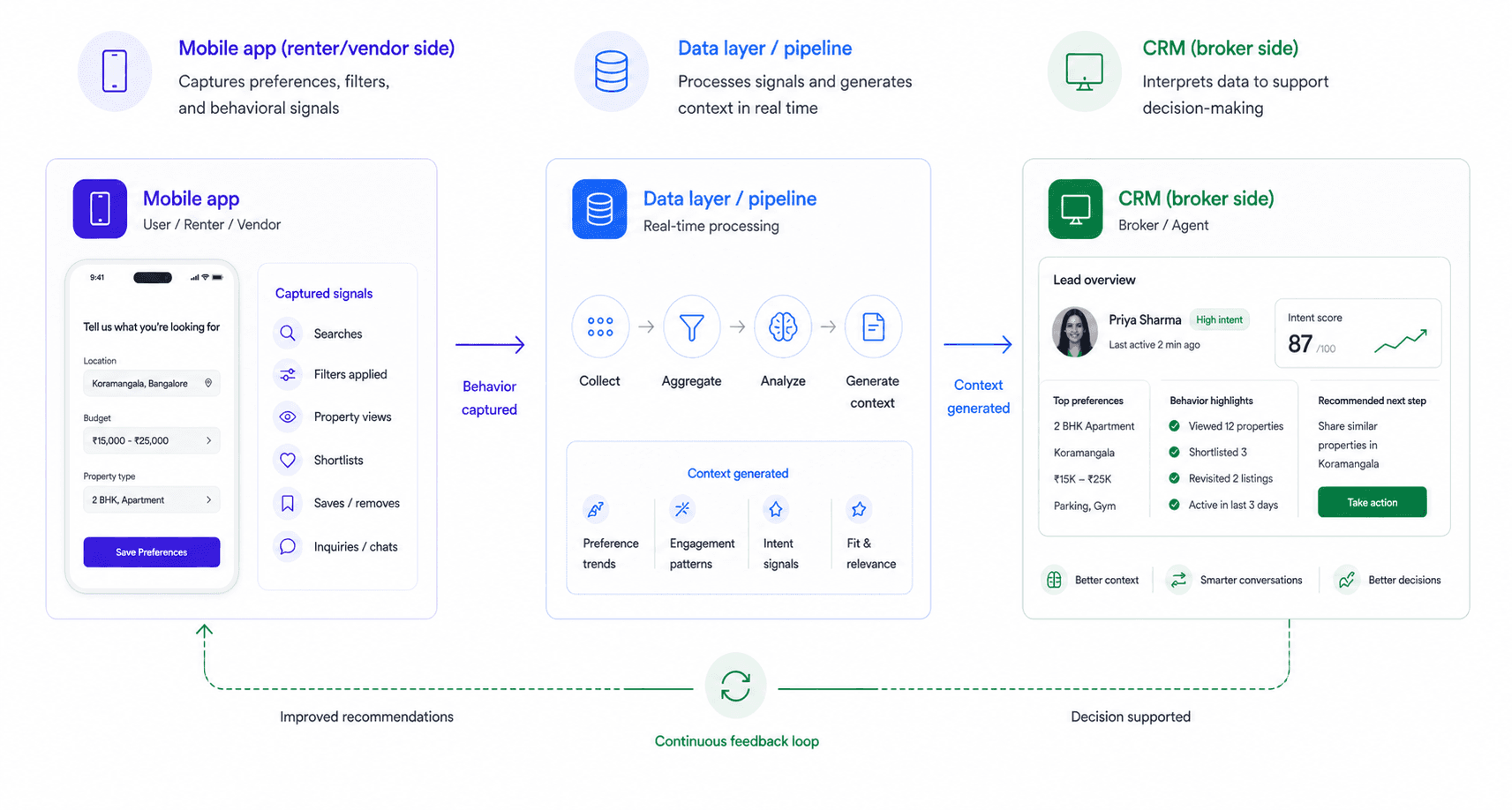
System Architecture: How the information will flow

Solution Map for the MVP flow
Final Design
Dashboard
The dashboard was designed with a single goal, give brokers everything they need to begin their day without jumping across multiple sections and tools. Instead of treating the dashboard as a reporting layer, we designed it as an operational launchpad that surfaced priorities, lead activity, and workflow status at a glance.

Pipeline at a glance
Four KPI tiles, New Leads, Qualified Leads, Scheduled Visits, and Negotiation Stage, were surfaced at the top of the dashboard to give brokers an immediate understanding of their pipeline. The goal was to remove unnecessary navigation and make critical workflow information visible the moment they opened the platform.
Source-aware lead acquisition chart
The system surfaced lead acquisition by source to help brokers move beyond passive tracking and make better operational decisions around channel performance and lead quality.
Action-first design "View New Leads" is the primary CTA
The dashboard prioritized operational readiness over analytics depth by surfacing high-priority lead activity upfront and reducing the steps needed to begin daily workflows.
Smart Leads
One of the biggest workflow challenges brokers faced was deciding which lead needed attention first while managing multiple active clients simultaneously. Existing CRM systems stored information but did little to support prioritization.
We designed Smart Leads as a decision-support layer on top of the client database that surfaced lead urgency and intent based on behavioral activity rather than relying on opaque scoring systems.

Intent is behavioral, not scored
Lead intent levels like High, Medium, and Low were derived from observable behavioral signals such as inquiry submissions, property viewing activity, and alignment between browsing patterns and stated budget preferences. Instead of relying on a hidden scoring system, the platform made the reasoning behind prioritization visible so brokers could understand and trust the recommendations.
Broker stays in control: Accept or Deprioritise
Brokers could either Accept a lead into their active pipeline or Deprioritize it based on current intent signals. Deprioritized leads were not removed from the system, they were simply taken out of the active workflow and automatically resurfaced if engagement behavior changed over time. This reflected an important product decision: lead intent was treated as dynamic and context-dependent rather than fixed or permanent.
Preference pattern and behavioral signals shown together
Each lead card surfaced both the client’s preference profile, including budget, location, property type, and timeline, alongside the behavioral signals influencing the intent classification. The system was designed to support broker judgment rather than override it, allowing brokers to disagree with recommendations and make their own prioritization decisions when needed.
Matched properties surface automatically
Relevant property matches were surfaced directly within each lead card based on the client’s preference and behavioral patterns. This helped brokers begin conversations with context and actionable options instead of manually searching for properties during or after the interaction.
Client Database
The key design decision within the Client Database was introducing a status-driven workflow view instead of a static contact list. Each client was tagged by their current stage, such as Active Lead, Awaiting Action, or Completed, allowing brokers to quickly understand what required attention. The status-tagged structure transformed the database from static information storage into an actionable workflow management system that supported faster prioritization and task coordination.

Status tags as the primary navigation signal
Status tags like Active Lead, Awaiting Action, and Completed helped brokers instantly understand where attention was needed. Instead of relying on filters or manual sorting, the system surfaced the highest-priority clients upfront to support faster decision-making and workflow management.
Full preference context in the table row
Key client details like property type, preferred location, and budget range were surfaced directly within the list view so brokers could quickly understand context without opening individual profiles. The goal was to reduce memory load and support faster lead evaluation during high-volume workflows.
Client Profile
The client profile was designed as a centralized workspace where brokers could manage an entire client journey in one place. The challenge was balancing information density with usability by organizing preferences, tasks, documents, property matches, and interaction history without overwhelming brokers managing multiple active clients simultaneously.
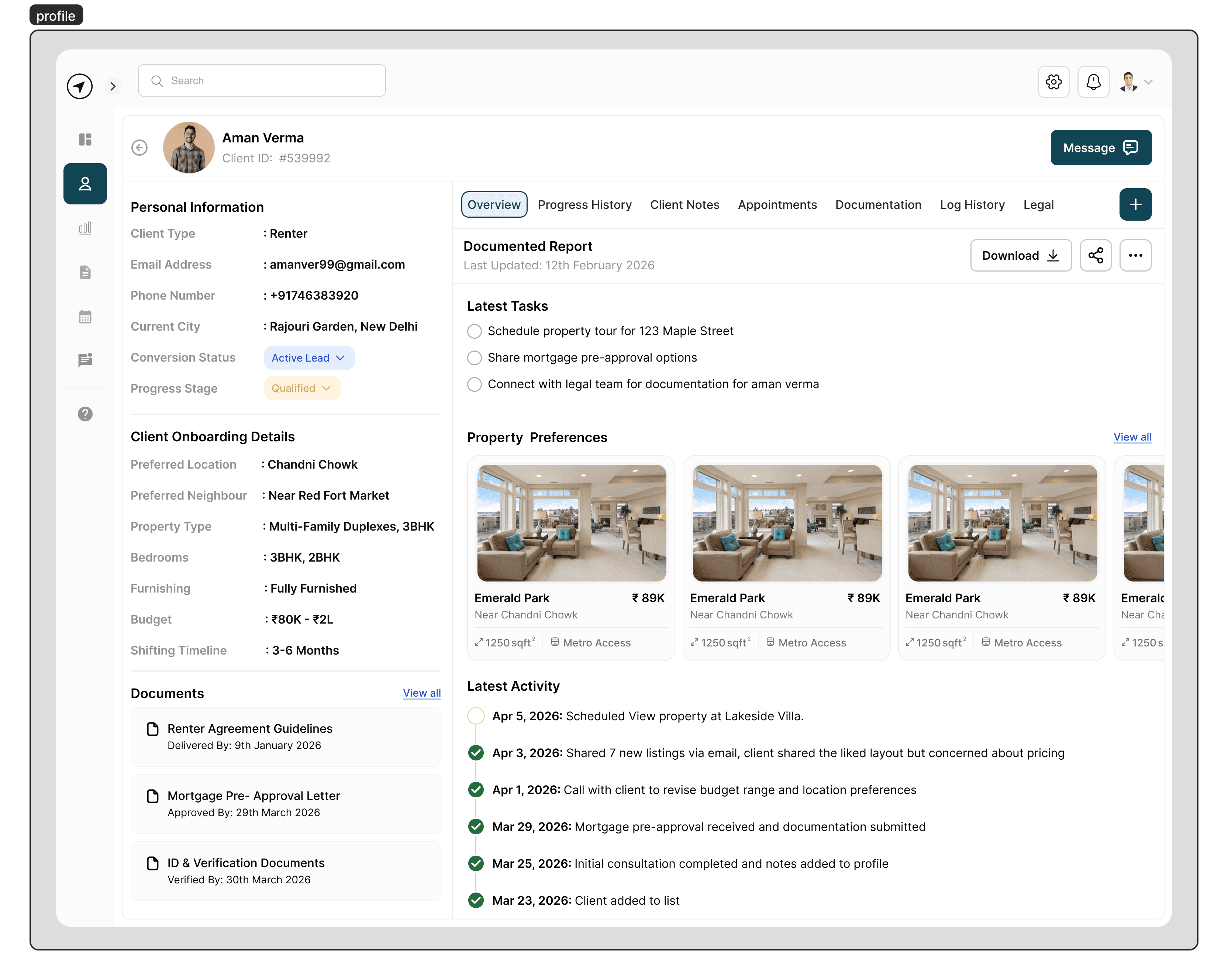
Preference + behavioral history on the same page
The profile was structured to separate stated intent from actual behavior. The left panel captured static client preferences like budget, location, and property type, while the right panel surfaced real interaction history through an activity log. This helped brokers quickly identify whether a client’s actions aligned with what they initially said they were looking for.
Tasks with clear ownership
By integrating task management into the client workflow itself, the system reduced coordination overhead and made operational follow-ups consistently visible.
Matched properties surfaced from preference data
Relevant property matches were surfaced directly within the client profile based on both stated preferences and observed behavioral signals. Instead of requiring brokers to repeatedly search across listings, the system brought high-relevance options into the workflow automatically to support faster coordination and decision-making.
Messages
The Messages experience was designed to solve one of the most consistent workflow pain points brokers mentioned during research: fragmented communication management. Brokers were juggling conversations across WhatsApp, phone calls, and SMS without a centralized view, which often led to missed context, repeated conversations, and lost follow-ups.

All client conversations in one searchable inbox
All client conversations were centralized into a single searchable and filterable communication view. Instead of switching between WhatsApp, missed calls, and emails to reconstruct context, brokers could access the entire interaction history in one place.
Presence indicator know when to reach out
Online activity indicators helped brokers make better timing decisions around communication. Instead of only showing who to contact, the system also surfaced when a client was recently active, allowing brokers to prioritize outreach when engagement likelihood was higher.
Recency timestamps surface cold leads
Conversations were sorted by recency and engagement urgency so brokers could quickly identify which clients required follow-up attention. Leads with no recent interaction automatically surfaced higher in the workflow, reducing the risk of missed communication and forgotten follow-ups.
Design Decisions during the process: What we chose not to build and why that mattered.
Strategic scope reduction played a critical role in product adoption by preventing unnecessary complexity and keeping the system aligned with real operational behavior.
Skipped
Fully automated property matching
Instead
Smart Leads with visible reasoning and broker override
Skipped
Complex onboarding flow for Brokers from tier 2/3 cities
Instead
Familiar Patterns like table view, search, status tags , things they understand
Skipped
Real-time intent scoring
Instead
Daily refresh with clear behavioral signal explanation
Skipped
Deleting deprioritized leads
Instead
Soft deprioritization its removed from active view, retained in system
Reflection
This project changed the way I think about design. I went into it assuming the problem was around property discovery and renter experience, but research showed that the real friction existed behind the scenes in broker workflows. It taught me the importance of understanding the ecosystem deeply before jumping into solutions.
The biggest challenge was designing within a market that is highly unstructured and relationship-driven. There was no existing system, no standard workflow, and no clear product direction at the beginning. Balancing real-world broker behavior with scalable system design required constant iteration and difficult tradeoffs around structure, flexibility, and simplicity.
One of my biggest learnings was that good product design is not about adding more features, it is about reducing chaos and making workflows clearer. I also learned how valuable systems thinking and research synthesis are in shaping product decisions.
If I were to continue this project, I would spend more time testing long-term broker adoption and validating workflows in live environments instead of only prototype-based testing. I would also explore how AI could help brokers understand preference patterns and prioritize leads more intelligently without removing the human aspect of their work.
Copyright ©2026. All right reserved Ananya Vashist